The Time I Waited Too Long
We were most of the way around the block on a Tuesday evening when Rowan stopped putting weight on a back leg for three or four steps. Then he shook it out and kept walking, and by the time we got to the driveway he looked normal again. I remember thinking, out loud, in the voice you use on a dog who is not listening: “You are fine, buddy.”
I want to be honest about what happened next, because it is the part I skip when I tell this story at a party.
The story I told myself
Within about ninety seconds I had built a complete explanation. He had been tearing around the yard that weekend. He is a big goofy dog who does not know how to slow down on a turn. He had probably pulled something. Rest it, keep the walks short, it will settle.
None of that came from anybody who knows anything. It came from me, standing in a driveway, wanting it to be true. And because I had an explanation, I stopped collecting information. That is the actual failure. Not the wrong guess, the fact that the guess closed the question.
Two weeks of watching it, which was not watching it
I told myself I was monitoring the situation. What I was really doing was checking whether it looked bad enough to override my own conclusion. Some days he was fine. Some days he was a little slow getting up. I filed the good days as evidence and the bad days as noise.
My schedule helped me out here, which is the worst kind of help. The clinic’s non urgent hours overlapped almost exactly with my meetings. Every time I thought about calling, it was either too early or right in the middle of something, and by evening it had moved down the list. If I had actually believed something was wrong I would have found the twenty minutes. I know that now.
The couch was what finally got through to me
The thing that broke it was not the limp. It was the couch.
Rowan has one particular end of the sofa that he owns, and getting onto it has been a launch and a thump since the day he arrived. That has never been graceful and it has never been optional. One evening I noticed he was standing next to it instead. Not whining, not making a scene. Just standing there looking at it. Then he lay down on the floor.
He did it again the next night. That was the moment my explanation fell apart, because a strain that is healing does not make a dog quietly give up a piece of furniture he has fought me for since he was a year old. Home tells you things if you are paying attention to the routines rather than the symptoms. He had rearranged his whole evening around a problem and I had spent two weeks looking at his leg.
What the visit was actually like
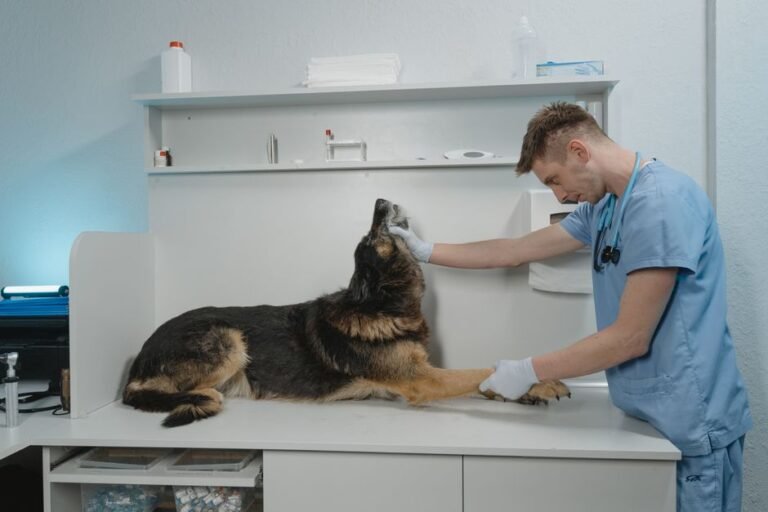
I called the next morning and we went in that week. Our vet did the exam, asked me a lot of questions I answered badly because I had not written anything down, and then said the sentence I still think about: “How long has this been going on?”
Not accusing. Just asking, because the answer changes things. I said two weeks and heard how it sounded coming out of my mouth.
I am not going to describe what she found or what we did about it, partly because it was specific to him and partly because I genuinely do not think a stranger reading this should take anything from it about their own dog. What matters here is what she told me about the delay: it did not create the problem, but the two weeks had not been free, and some of what we then had to deal with was the result of a dog compensating for something for a fortnight.
That is the part I earned. Not the original issue. The compensating.
The rule I keep now, written down
I have a note in my phone, and it is short because a long one would not survive contact with a busy week.
If something is still there on the third day, I call. Not go in necessarily, just call the clinic and describe it and let the vet decide whether it is a come in or a keep an eye on it. That call has cost me nothing more than a few minutes several times since, and twice it turned into an appointment I would not have booked on my own judgment.
The second half of the rule: I do not get to decide what it is. I can describe what I see. When it started, how often, whether he is eating, whether he is using the stairs, whether anything at home changed. Then I hand that over to the vet, and whatever it turns out to be is her call. Every time I have tried to skip that step and go straight to a conclusion, I have been building a story, and I am very good at building stories that let me stay on the sofa.
What I actually track now
Because I answered those questions so poorly at that appointment, I keep a running note. It is not medical and it is not clever. It is a date and a line. Slow off the bed this morning. Ate normally. Skipped the last block. Two flights of stairs, no problem.
Three of those lines in a row look different from any one of them alone, which is exactly what I could not see when it was all happening in my head. And when I do call, I can give a real timeline instead of “a couple of weeks, I think.”
Rowan is fine now. He is back on his end of the couch and he still lands on it like a dropped bag of laundry. But I lost some faith in my own read that spring, and honestly that was worth more than the visit.