Rearranging the House Around an Older Dog
The first sign was a sound. Five in the morning, still dark, and I could hear Rowan’s nails scrabbling on the kitchen tile. Not once. Four or five attempts, then the click of him finally getting up and walking off. I lay there listening to it and understood that it had been happening for a while and I had been sleeping through it.
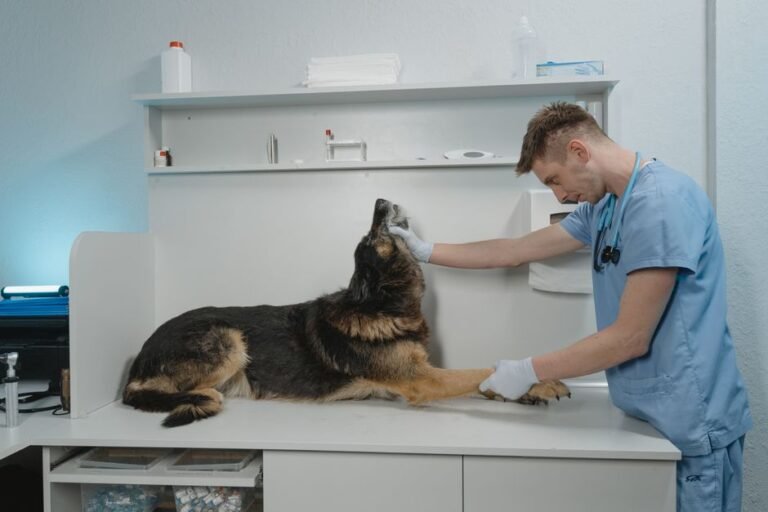
He is not ancient. He is at the stage where you start noticing that the dog who used to clear the back steps in one go now does them one at a time. That is not a crisis and it did not send me to the clinic that morning. It did make me start paying attention differently, and I brought it up at his next visit rather than filing it under “getting old” and moving on, because “he is just old” is a conclusion and I have learned not to reach those on my own.
Rugs, laid out like a path
The single biggest change in this house was cheap and ugly. I put runners down.
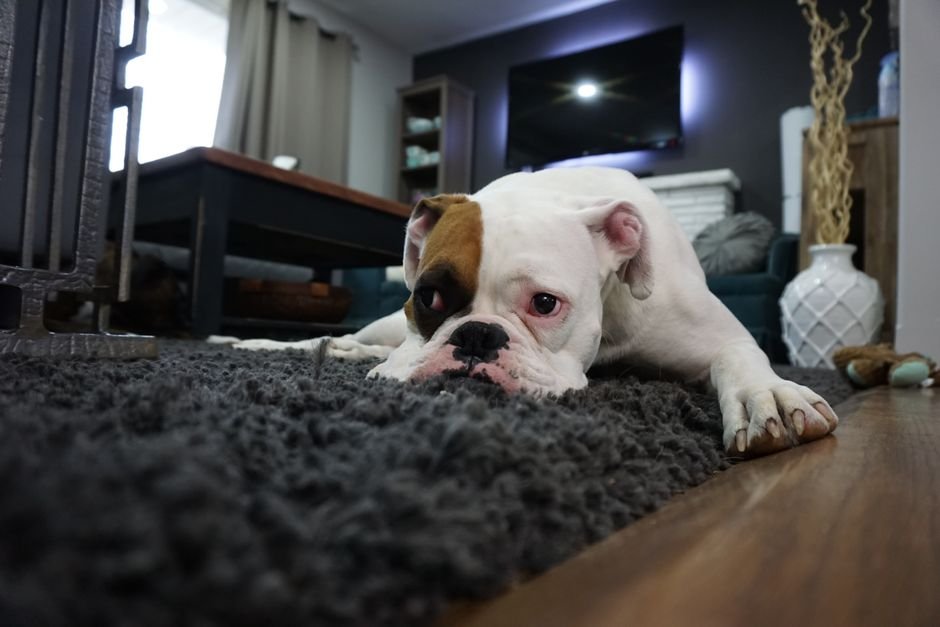
Our main floor is hard flooring throughout, which we chose because of fur and mud and everything else that comes with two animals. It is wonderful for cleaning and it is a skating rink for a dog whose back end is not what it was. So I mapped where he actually walks, which took about two days of watching, and it turned out to be a very consistent route: bed to water bowl, water bowl to back door, back door to the spot by the window, window to the couch.
I laid runners along that route with as few gaps as I could manage. Not a rug in the middle of each room for looks. An actual continuous path. The difference showed up within a day: no more scrabbling, and he stopped doing the cautious little pause at the doorway where the tile started.
Rubber backing matters, and I found that out by buying two that slid. Those are now in the basement.
Lowering things, but asking first
The couch was next. He has always launched onto it, and I could see him thinking about it beforehand in a way he never used to. I got a ramp. He ignored it completely for about ten days.
What worked was putting it there and doing nothing about it, then feeding him next to it, then eventually on it. The mistake I made was standing at the top calling him, which turned it into a test he could fail.
Before I changed anything about his bowls, though, I asked. There is a lot of confident advice out there about raising food and water for older dogs, and it is presented as an obvious universal improvement. I brought it up at his check up instead, described the actual thing I was seeing, and got a specific answer for this specific dog rather than a rule. I would not have thought to ask a year ago. I would have just bought the stand because a website told me to, and it genuinely had not occurred to me that the answer could go either way depending on the animal.
Nights got their own set of changes
Older dog, more getting up in the night. Two small things helped more than they should have.
A couple of low plug in lights along the hallway, the kind meant for people who do not want to hit a light switch at three in the morning. He navigates fine, but he was hesitating at the top of the hall, and the hesitating stopped.
And a second water bowl, upstairs, so the trip is shorter. That one came out of a conversation at the clinic, because when I mentioned he seemed to be drinking more, our vet asked me several questions about it that I had not thought to ask myself, and that turned into something worth actually keeping track of rather than something worth solving with a second bowl. The bowl was the convenience. The tracking was the point.
The thing I bought that he hated
I want this one on the record because I was so pleased with myself.
I bought a large orthopedic bed. Thick, supportive, the whole thing. I set it up in the corner of the living room where it looked good and where I thought a dog would want to be, which is to say out of the traffic and away from the noise. He would not use it. He would walk past it and lie down on the floor in the doorway of the kitchen, which is the least comfortable and most inconvenient spot in the house.
It took me two weeks to work out that I had solved the wrong problem. He did not want a better bed in a quiet corner. He wanted to be where people were. I moved his old flat bed into the middle of the room where we actually sit, and he used it that evening. Eventually I swapped the new one into the same spot and he took to it fine.
The cushioning was never the issue. Location was. I had bought a solution to a problem I invented.
Mabel has opinions about all of this
The cat is younger and still gets everywhere she wants, but the rug situation changed her routes too, mostly in her favour. She has claimed the runner by the window that I put down for the dog.
The one thing I have changed for her is height. She used to go counter to shelf in one move and I noticed she started using the back of the chair as a middle step. That is the kind of small change I now write down with a date rather than shrug at, because I know from Rowan that a slow behaviour change over months is exactly the sort of thing I am bad at seeing and someone at the clinic can ask useful questions about.
What the house teaches you
Almost everything I noticed about my dog getting older, I noticed through furniture. The couch he stopped jumping on, the step he started taking twice, the floor he began avoiding, the bed he would not lie in. Not through anything that looked like a symptom.
So I pay attention to the house now. And when the house tells me something has changed, that goes to the vet as a description, with dates, and I let somebody qualified decide whether it means anything. My job is to notice and to make the place easier to live in. It stops there.